Commercial Coffee Grinders

Explore our range of commercial coffee grinders for cafes, restaurants, roasteries and professional setups. It includes on-demand espresso grinders, grind-by-weight and grind-by-sync models, and bulk grinders for filter, cold brew and retail. Our extensive lineup caters to different budgets and covers flat burr sizes from 54 mm up to 98 mm. For a rounder cup and quieter service, we also carry conical burr models at 63 and 71 mm. Bean hoppers run from under 1 lb on compact grinders to over 4 lb on high-volume models, so you can match capacity to how much you grind between refills.

We carry leading professional coffee grinder brands including Mahlkönig, Fiorenzato and Eureka, plus renewed and open-box commercial grinders inspected and ready for service. Every order ships free, financing is available on most models, and our team offers free consultation to help you match a grinder to your machine, menu and daily volume.

What Makes a Coffee Grinder Commercial, and Which Type Fits Your Bar?

A commercial coffee grinder differs from a home one in three places: burrs, motor and serviceability. Commercial burrs run from about 64 mm up to 98 mm across, and a bigger burr does the same job in fewer turns, so it grinds faster and runs cooler. That matters in a rush, because heat shifts grind size and the shot you dialed in at open starts running fast by noon. The motor is rated for continuous service rather than a few doses a morning, and the burrs are made to be replaced, so the grinder lasts years instead of being retired when the burrs dull.

The next call is how it doses. An on-demand grinder grinds straight into the portafilter when you press the button, either for a set time or, on grind-by-weight models, until the coffee on the scale hits your target. Every dose is freshly ground, nothing sits waiting, and you can change the dose without touching the machine. A doser grinds ahead into a chamber and releases it by lever. It is quick, but the grounds age while they wait and you throw away what's left at close. Most espresso bars now choose on-demand, and dosers mostly survive where one blend runs flat out all day.

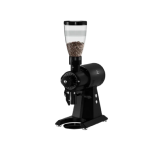
Then match the grinder to the job, not just the coffee. For espresso, the 65 to 80 mm flat-burr on-demand models are the working standard. They give a clean, even cup and keep up with a busy two or three group machine. Conical burrs tend to give a rounder, heavier cup and are often more forgiving on sound and heat, which suits restaurants and quieter rooms. If you also brew batch filter, cold brew or bag coffee for retail, a large-burr grinder like the Mahlkonig EK43 handles the coarser sizes that espresso grinders can't. Our bulk coffee grinders page covers that side.

Finally, size it to volume. A bar pulling around 200 doubles a day grinds about 3.5 kg of coffee, so look for a grinder whose burrs and motor won't be working flat out to do that. Most cafes also want two grinders, one for the house blend and one for decaf or a guest coffee, so you're not purging between them. If you're choosing a machine at the same time, our commercial espresso machines are the natural pair. And if you're shopping for a kitchen counter rather than a bar, you'll want our home espresso grinders instead.

FAQ

What is the difference between an on-demand and a doser grinder?

An on-demand grinder grinds each dose fresh when you press the button, so nothing sits in the machine. A doser grinds ahead into a chamber and releases a set amount by lever. Dosers are quick, but they leave stale grounds to throw away at close, which is why most new espresso bars go on-demand.

What is the best commercial coffee grinder for espresso?

The best one is the one sized to your bar. For most cafes, that's a flat-burr on-demand grinder with 64 to 80 mm burrs and stepless adjustment, so you can fine-tune the grind as beans and humidity change. If you're pulling high volume or serving several espressos, step up to bigger burrs or grind-by-weight.

Do I need a grind-by-weight grinder?

You need one if dose consistency is costing you shots. A timed grinder's output shifts as bean density and hopper level change, so someone ends up checking on a scale. Grind-by-weight stops at your target grams, so every basket matches. It earns its keep when staff turn over often or you serve a lot of single origins.

How big should the burrs be for a coffee shop?

For most cafes, 64 to 75 mm flat burrs cover steady espresso service. Go to 80 mm or more when one grinder feeds several groups at peak or you pour a lot of drinks in short bursts. Bigger burrs grind faster and run cooler, so your grind holds through the rush.

How many coffee grinders does a cafe need?

Usually two. One carries the house espresso and one carries decaf or a rotating guest coffee, so nobody purges a grinder between orders. A single-blend bar or a small restaurant can run on one. Add a third if you also brew filter or cold brew and want a dedicated grinder for the coarser grind.

How much does a commercial coffee grinder cost?

Entry-level commercial espresso grinders start at around $1,000, mid-range on-demand models with bigger burrs run roughly $1,500 to $3,000, and high-volume and grind-by-weight models go higher. Bulk grinders for filter and retail sit in a similar spread depending on burr size and output. Spending more mainly buys speed, heat control and dosing accuracy, so size to your busiest hour, not your average one.

Can I use an espresso grinder for batch brew or cold brew?

Not quite. Espresso grinders are built for fine to medium settings, and their burrs are tuned for that range. Filter and cold brew want a coarse, even grind in larger batches. A bulk grinder with large burrs handles that, and plenty of cafes keep one next to their espresso grinders.

Should I buy a commercial coffee machine with a built-in grinder?

It depends on who's making the coffee. Super-automatic machines grind and brew in one unit, which suits offices, self-serve stations and venues without a trained barista. For an espresso bar, a separate grinder gives you far more control over grind and dose, and if one unit goes down for service, the other keeps working.

How do you clean a commercial coffee grinder?

Brush out the chute and around the burrs at the end of every day, and empty and wipe the hopper so coffee oils don't build up. Once a week, run grinder cleaning tablets through to lift oils from the burrs. Every month or so, take the burrs out for a full clean. Never use water inside the grinder, and check your model's manual before taking it apart.

How often do commercial grinder burrs need replacing?

It depends on the burr and the coffee, but a busy cafe typically replaces them every year or two. The signs are shots running slower, grind times creeping up and the cup tasting flat even after you've adjusted. Check the maker's kilo rating for your model and keep a spare set on hand.

Are commercial coffee grinders loud?

Louder than a home grinder, since the motors are bigger, but it varies a lot by model. If you need a quiet commercial coffee grinder, look at conical models running at lower speeds, which suit restaurants and open-plan rooms. Flat-burr grinders are faster and usually louder, but they only run for a few seconds per dose.

Will a commercial grinder fit my espresso machine?

Almost certainly. Most commercial grinders feed a standard 58 mm portafilter, so grinders and machines mix and match across brands. What's worth checking is the portafilter fork, since some hold the portafilter hands-free and some need you to hold it, and the grinder's height against your counter and cabinets.