Bulk Coffee Grinders

A bulk coffee grinder has a different job from the one on your espresso bar. It grinds coarse, it grinds a lot in one go, and it feeds a batch brewer or a retail bag rather than a portafilter. That changes what you should be looking at: how the burrs are cut, how quickly a dose clears, and whether the grinder works to a recipe instead of a shot timer. Get this wrong and every pot on the counter tastes slightly off, and you won't know why until closing. Get it right and your filter coffee holds up as well as your espresso does.

How Do You Choose a Grinder for Batch Brew and Bulk Coffee Grinding?

Start with the burrs, because that is where a batch grinder stops being a big espresso grinder. Burrs are cut for a job. An espresso set works in a fine, narrow band; a filter set is cut to hold a coarse grind even across a much bigger dose. That is not a marketing line: makers in this category sell separate espresso burrs, separate filter burrs and a compromise set for the same grinder body. It matters because of what happens in the basket. Particles under about 100 microns, the fines, are what choke a bed of coffee and slow the water down. Get too many into a flat batch bed and part of it over-extracts while water channels past the rest, and you taste both in the same pot.

Then throughput, which decides whether the grinder ever holds up service. A filter-class grinder runs four to five times the output of an espresso grinder, around twenty grams a second against four to six, on roughly three times the motor. A sixty gram dose clears in about three seconds; a twelve ounce retail bag in under twenty. You are not waiting on it, and it is not cooking the coffee to get there.

Dosing works differently too, which catches people coming off the espresso side. Grind by weight has taken over espresso grinding and has barely arrived here. Batch grinders dose by recipe instead: a couple of programmable doses plus a continuous grind, or a grams-per-litre figure set on the brewer. Accuracy comes from calibrating that recipe and holding it, not from a scale in the base.

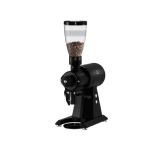
Last, half of what this category does is not brewing at all. Bulk grinding means beans into bags, for the to-go customer and the wholesale account, which is why these machines carry a bag clamp as standard kit rather than an accessory. So decide whether you want a large hopper feeding a steady house blend, or a near-empty one you can single-dose a different coffee through. Our commercial coffee grinders range covers the espresso side, and our commercial coffee brewers collection covers the brewer you are feeding.

FAQ

Do I need a separate grinder for batch brew if I already have an espresso grinder?

If you pour both, yes. Sharing one grinder means re-dialling and purging every time you switch, twice a day at minimum, and you throw away good coffee doing it. The compromise burr sets that handle both give up ground at each end, so neither drink is quite what it should be. A second grinder costs you counter space and buys back your morning.

What is the difference between a bulk grinder and a batch grinder?

Mostly nothing. The same shelf gets called bulk, batch, filter, retail, shop and bag grinding depending on who is writing the label, and the machines overlap heavily. The useful split is by job, not by name: grinding into a brew basket for batch coffee, and grinding into bags for customers. Most machines here do both well.

How much grinder throughput do I actually need?

Work from your busiest hour, not your daily total. One grinder in this class comfortably covers a hundred filter coffees an hour, and past about a hundred and fifty you should be planning a second one. Then check the other job: if you also grind retail bags during service, every bag is time the brewer is not being fed.

Can one grinder handle my house blend and decaf?

It can, but plan for the changeover. Whatever is left in the chute and burrs from the last coffee comes out in the first few grams of the next one, so decaf into a regular order means purging first. If decaf is a steady part of your volume, a second grinder or a swappable hopper removes the problem rather than managing it.

How often will I need to change the grind setting?

More often than you would like. Expect to check it at the start of every day, and to re-dial whenever you open a new bag, even the same coffee from the same roaster. Bean density, roast age and the weather all move it. Write down the setting that worked for each brew method so you are adjusting from a known point rather than guessing.

What grind setting should I start at for batch brew?

Start coarse and creep finer. Batch brew sits near the coarse end of a filter grinder's range, and going too fine is the classic mistake: the bed slows down, the grounds climb the sides of the filter, and the pot comes out bitter and flat at once. Set your dose by grams per litre first, hold it steady, then move grind size alone.

How long do the burrs last in a batch grinder?

Judge it in kilos, not months. Published burr life across this category runs from roughly 1,200 kg of coffee to around 6,000 kg depending on the burr set, so a calendar figure tells you very little. The signal to watch is drift: when the same recipe starts running faster and tasting thinner, the edges have gone.

Do these grinders need a dedicated electrical circuit?

Check it before you buy. A batch grinder can draw around three times what an espresso grinder does, and plugging one into a shared circuit alongside a brewer or a fridge is how people end up tripping a breaker mid-service. Confirm the machine's power draw against the circuit it will actually sit on, not the one on the drawing.

Will a batch grinder work with any brewer?

Most are standalone and will feed anything you brew into. A few are built as part of one brewing system, controlled from the brewer's screen and dosing to its recipe, and those will not run on their own or alongside a different machine. It is worth confirming before you commit, especially if the brewer is already installed.

Where should the grinder go on the bar?

Somewhere with height and a clear reach. These machines stand tall, and you need working room underneath for a full retail bag, not just a dosing cup. They are also loud and bulky enough to block sightlines, so keep them off the counter your customers order at. Put it on the path the person brewing already walks.