


Kees van der Westen Speedster Review: Commercial-Grade Stability in a Single Group (2026)
|
|
Time to read 10 min
Your Cart
Your cart
Favorites





Shop by Brands

Shop by Brands
Shop by Brands


Shop by Brands


Shop by Brands
Shop by Brands

|
|
Time to read 10 min
Rating: 4.6/5
Best for: solo-group specialty cafes, growing coffee carts, and serious home baristas who want commercial-grade thermal stability without a multi-group footprint.
The Speedster earns its keep with a dual-boiler layout and an adjustable pre-infusion chamber (with an optional Idro-matic progressive profile) that gives real control over extraction, not a fixed factory default. It is a semi-automatic, single-group machine, so every shot is started and stopped by hand and only one drink is in progress at a time, as long as you can live with that ceiling on throughput, it delivers genuinely cafe-grade consistency in a single-group footprint.

If your last three shots off the same beans have not tasted the same, the problem is rarely your grind. More often it is a machine that cannot hold its temperature once you start moving, brewing one shot while steaming milk for the next, then pulling another right behind it. I have run single-group machines that drift half a degree the moment the steam wand opens, and it shows up in the cup as inconsistency you cannot dial out with grind adjustments alone.
The Kees van der Westen Speedster is built to solve exactly that problem. It pairs an oversized coffee boiler with a dedicated steam boiler and heat exchanger, so brewing and steaming stop competing for heat. Handbuilt in the Netherlands and sized for a single group, it is aimed at anyone who wants a genuinely commercial-grade shot without committing counter space to a multi-group machine.
Single group, dual boilers: an oversized coffee boiler plus a 3.5 L steam boiler with a heat exchanger
Electronic PID temperature control, programmable from the machine's own LCD
Adjustable pre-infusion chamber, with an optional Idro-matic progressive pre-infusion upgrade
Mixed hot water dispenser for Americanos and tea, drawn independently of the brew boiler
Power draw: 220 to 240 V, 2200 to 3100 W, 10 to 14 A
Footprint: 48 in long, 65 in deep, 37 in tall, at 99.21 lbs before water and plumbing
Ships with: single and double spout portafilters, an external pump, and a full starter cleaning kit
Specialty cafes running a single, focused bar where shot-to-shot consistency matters more than raw ticket volume
Coffee carts and small satellite bars that want a real dual-boiler machine without the depth and weight of a multi-group unit
Home enthusiasts who already grind and dose carefully and want a boiler platform that will not drift mid-session
Trainers and roasters who cycle through different beans all day and need pre-infusion they can actually adjust, not just a fixed default
Buyers deciding between Standard and Idro-matic, who want progressive control over how pressure ramps into the puck
NOT for: high-volume bars running two or three tickets at once off the same counter, where independent multi-boiler groups earn their keep; the Kees van der Westen Spirit or Slim Jim is the better fit there.

Every part of the Speedster is built around one goal: keep the coffee boiler's temperature from moving once you start working. That shows up across five areas, from how the two boilers split their jobs to how the pre-infusion chamber treats the puck before full pressure arrives. Here is what actually changes the shot in daily use.

The pain point it solves: shot temperature drifting whenever the steam wand opens mid-session.
What makes it great: an oversized coffee boiler dedicated to brewing works alongside a separate 3.5 L steam boiler with a heat exchanger that pre-heats incoming water before it reaches the coffee boiler. An electronic PID holds and displays boiler pressure on the machine's own LCD, so brewing heat is never borrowed from the steam side.
The benefit: you can pull a shot and steam milk at the same time without either boiler falling behind, and five or six back-to-back shots still land in the same range.

The pain point it solves: uneven extraction on light roasts, where dry, dense pucks channel water instead of soaking evenly.
What makes it great: the brew path runs through an adjustable pre-infusion chamber that wets the puck at lower pressure before ramping to full brew pressure, a mechanical setting you control rather than a fixed default. The Idro-matic version makes that pre-infusion progressive, so the pressure ramp itself is adjustable.
The benefit: dense roasts that usually fight the portafilter saturate evenly first, cutting channeling and giving a real dial-in variable beyond grind and dose. Buyers who rotate through roast profiles tend to prefer Idro-matic's adjustable ramp; buyers who want simpler and repeatable are well served by the Standard chamber.
The pain point it solves: running low on steam mid-rush, or choosing between hot water for an Americano and keeping the steam boiler ready for milk.
What makes it great: a 3.5 liter steam boiler is large for a single-group footprint, and the heat exchanger separating it from the coffee boiler means it recovers without stealing brew temperature. A mixed hot water dispenser draws tempered water independently, off its own circuit.
The benefit: you can push through several milk drinks with fine, stable microfoam, then pull hot water for a tea order without touching the next espresso's shot temperature.

The pain point it solves: bar equipment that looks impressive on delivery day and starts feeling cheap within a year of service.
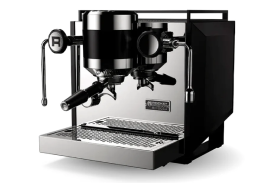
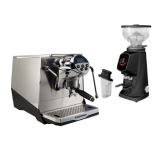
What makes it great: the body is finished in polished metal panels with the signature curved side plate carrying the Speedster badge, each panel shaped and fitted rather than stamped from a single sheet. Service access is designed in from the start, with panels that come off quickly and boilers positioned for routine work without a full teardown.
The benefit: it holds up as a genuine display piece while staying serviceable long after the newness wears off, which matters more on a machine you plan to keep for years.

The pain point it solves: a machine this capable arriving on site only to sit unused because the power or plumbing was not sorted out first.
What makes it great: it runs on a 220 to 240 V supply drawing 2200 to 3100 W (10 to 14 A), ships with an external pump and its own electric motor, and needs water near 40 to 70 ppm alkalinity, zero chloride, and a pH near 7 to protect both boilers.
The benefit: planning the circuit, drain, and filtration before delivery day means the machine is pulling shots the same week it arrives, not sitting boxed while an electrician gets scheduled.
The Speedster is easiest to evaluate against what it actually asks of you, not just what it delivers.
|
Pros |
Cons |
|
Dual boiler layout keeps brewing and steaming from competing for heat |
Single group head, so only one drink can be in progress at a time |
|
Adjustable pre-infusion chamber, with progressive control on Idro-matic |
Semi-automatic operation: every shot is started and stopped by hand, with no volumetric auto-stop |
|
Large 3.5 L steam boiler for sustained milk output |
48 in by 65 in footprint is still substantial for a one-group machine and needs real counter planning |
|
Oversized coffee boiler holds temperature through back-to-back shots |
Requires a dedicated 220-240 V circuit and an external pump, which most home kitchens are not already wired for |
|
Mixed hot water dispenser independent of the brew circuit |
Sits at a premium price point that reflects handbuilt construction and commercial-grade components |
|
Compact single-group footprint next to multi-group Kees van der Westen machines |
Learning curve on pre-infusion and extraction adjustments for anyone new to manual, adjustable pre-infusion |

|
Specification |
Detail |
|
Boiler Type |
Dual Boiler (oversized coffee boiler + steam boiler with heat exchanger) |
|
Number of Group Heads |
1 |
|
Steam Boiler Capacity |
3.5 L |
|
Temperature Control |
Electronic PID, programmable via onboard LCD |
|
Pre-Infusion |
Adjustable pre-infusion chamber (progressive pre-infusion on Idro-matic) |
|
Hot Water System |
Mixed hot water dispenser |
|
Configurations |
Standard, Idro-matic |
|
Length |
48 in |
|
Depth |
65 in |
|
Height |
37 in |
|
Weight |
99.21 lbs |
|
Voltage |
220-240 V |
|
Amperage |
10-14 A |
|
Wattage |
2200-3100 W |
|
Water Requirements |
40-70 ppm alkalinity, 0 chloride, pH near 7 |
|
Included Accessories |
Single and double spout portafilters, external pump with electric motor, water supply hose, discharge hose, tamper, blind filter, group brush, screen extractor, drain hose, cleaning powder, shot glasses |
|
Warranty |
12-month parts warranty |
The Speedster sits at the compact end of Kees van der Westen's lineup, worth seeing next to the brand's bigger multi-group machines before you commit counter space to it.
The Kees van der Westen Spirit moves to independent boilers per group in a Duette or Tripette configuration, aimed at bars running genuinely high volume across two or three heads at once. The Kees van der Westen Slim Jim sits between the two, offering two or three groups with independent brew boilers in a narrower frame than the Spirit. Both step up in operating complexity and footprint versus the Speedster's single group, and both make more sense once a bar is regularly running more than one ticket at a time. If your counter only needs one group running well, the Speedster's simpler dual-boiler system is less to install and maintain over the life of the machine.
|
Feature |
Speedster |
Spirit |
Slim Jim |
|
Boiler Type |
Dual Boiler |
Multi-Boiler (independent per group) |
Multi-Boiler (independent per group) |
|
Group Heads |
1 |
2 or 3 (Duette/Tripette) |
2 or 3 |
|
Steam Boiler Capacity |
3.5 L |
10.5 L or 19.5 L |
10.5 L |
|
Pre-Infusion |
Adjustable chamber (progressive on Idro-matic) |
Pre-infusion pressure profiling |
Pre-infusion chamber |
|
Operation |
Semi-automatic |
Auto-volumetric with lever controls |
Auto-volumetric |
|
Best Suited For |
Single-group cafes, carts, and home bars |
High-output specialty bars |
Medium to high-volume multi-group bars |
Kees van der Westen has spent decades building espresso machines by hand in the Netherlands, and the brand's reputation was built on machines like the Mirage and Duette, spring-lever designs still sought after by operators who want a mechanical, hand-actuated connection to every shot. The Speedster and its dual-boiler siblings trade that spring lever for electronic PID control and a mechanical pre-infusion chamber, but the same handbuilt approach to panels and finish carries over.
We tested the Speedster the way we test every machine we review: pulling shots across a full session, cycling the steam wand under load, and checking how boiler temperature held once the machine had been running for an hour, not just on the first shot of the day.
Live, dynamic pricing on the product page, always reflecting the current configuration
Backed by free shipping within the contiguous United States
A 12-month parts warranty on the build
Access to lifetime Pro support for consultation, troubleshooting, and buying strategy, before and after your purchase
On a machine at this level, the value is less about the checkout screen and more about what happens before and after it. A quick conversation with a specialist before you order can settle whether you need the Idro-matic upgrade or the standard pre-infusion chamber, whether your existing circuit and water setup are ready for it, and how it will actually perform against your daily volume, the kind of guidance a plain online listing will not walk you through.
The Speedster makes the most sense if you run, or want to run, a single group extremely well: a specialty cafe, a growing cart, or a home setup where you want commercial thermal stability without commercial floor space. It is not the machine for a bar juggling three tickets at once, and it is not a machine you run on autopilot, every shot is manual. For the buyer it fits, the combination of dual boilers, adjustable pre-infusion, and handbuilt construction is hard to match at the single-group level.
If you are still deciding between the Standard and Idro-matic configurations, or whether a single group covers your volume, a conversation with a Pro Coffee Gear specialist before you order is worth having. Otherwise, head to the Speedster product page to see current configurations.
If you are running, or planning to run, a single group extremely well, yes. The dual-boiler platform and adjustable pre-infusion give you thermal stability and shot control most single-group machines cannot match, though it is a harder case once your volume needs two or three heads running at once.
Budget roughly 10 to 15 minutes for both boilers to reach stable brewing and steaming temperature. The heat exchanger keeps that warm-up consistent rather than something you have to babysit.
Daily group cleaning and backflushing, plus wiping the body and steam wand after each session, keeps it running as intended. Schedule a deeper clean and a water quality check weekly to protect the boilers.
Bars running high ticket volume across multiple stations should look at a multi-group machine, since a single group is built for focus, not raw throughput. Buyers who want fully automatic, volumetric shots with no manual timing should also look elsewhere.
Standard pre-infuses the puck at a fixed lower pressure before ramping to full brew pressure. Idro-matic makes that pre-infusion progressive, so the pressure ramp itself is adjustable, giving more control when dialing in beans prone to channeling.
Our team can help you find the best fit based on your space, volume, and budget.
Talk to a Specialist

