

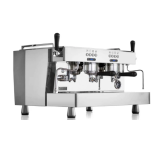

Slayer Steam LP Review: Shot-for-Shot Consistency for High-Volume Cafes (2026)
|
|
Time to read 10 min
Your Cart
Your cart
Favorites





Shop by Brands

Shop by Brands
Shop by Brands


Shop by Brands


Shop by Brands
Shop by Brands

|
|
Time to read 10 min
Rating: 4.6/5 | Best for: high-volume specialty cafes and multi-barista bars that need shot-level consistency and enough steam capacity to keep up with a milk-heavy menu.
The Slayer Steam LP gives every group its own pre-heated brew boiler, PID control down to 0.1 degrees, and a shot-record-and-replay system that turns your best pull into a repeatable house standard. Its steam capacity (7.4 L on the 2-group, 12 L on the 3-group) is built to survive a real rush without recovery lag. The trade-off is that this is a 220V machine drawing up to 35A on the 3-group and needing up to 44.5 inches of counter width, so you are committing to a proper commercial electrical and space plan before it ever pulls a shot.
If your morning bar looks like three different cafes depending on which barista is on the machine, the problem usually is not the beans. It is that every group head runs its own small variance in temperature, pressure, and timing, and by the time the third ticket lands, the first shot and the tenth taste nothing alike. I have pulled shots on a lot of multi-group commercial machines chasing that consistency, and the Slayer Steam LP is one of the few that actually closes the gap between what the head barista dials in and what every other shift produces. It does that with independent pre-heated boilers per group, a shot-record function that saves a profile instead of a memory, and enough steam capacity to keep milk drinks moving without a recovery penalty.
Dual manual and volumetric modes, with four programmable shot volumes per group
Shot record and playback for repeatable, trainable pressure profiles
Independent pre-heated brew boilers with PID control adjustable in 0.1 degree increments per group
Steam boiler capacity of 7.4 L on the 2-group or 12 L on the 3-group
Adjustable pre-infusion for specialty and single-origin espresso
Electronic solenoid steam valves for consistent, low-maintenance steaming
Low-profile countertop design built for technician access and barista-customer interaction
Multi-barista specialty cafes running back-to-back rushes on 2 or 3 groups that need shots to stay identical from group to group and shift to shift.
Training-focused cafes and multi-location brands that want a head barista's dial-in saved as a shot record instead of re-taught by feel every time staff turns over.
High-volume commercial bars with a heavy milk-drink menu, where 7.4 to 12 liters of steam capacity keeps lattes and cappuccinos moving without a recovery wait.
Specialty-focused operators pulling single-origin and light-roast espresso who want adjustable pre-infusion to protect a delicate extraction.
NOT for: single-barista carts, pop-ups, or small home setups without commercial-grade 220V electrical, since the Steam LP starts at 2 groups and draws up to 35A on the 3-group. If your bar does not need cafe-scale volume, a single-group prosumer machine like the one in our Rocket Espresso Boxer Timer review is worth a look instead.
The spec sheet reads well, but what actually matters is how these features behave once the line is five deep. Here is what stood out group by group.

The pain point it solves: A single-mode machine forces every barista into the same workflow, whether they are hand-timing a delicate single-origin shot or just trying to clear a queue of ten identical oat milk lattes.
What makes it great: The Steam LP runs the paddle actuator for full manual, feel-based extraction, or four programmable volumetric shot volumes per group for pre-set, repeatable pours.
The benefit: One machine covers the craft bar and the rush without asking either the barista or the recipe to compromise.
The pain point it solves: A great shot dialed in at 7am is easy to lose by 11am once a different barista, or a tired version of the same one, is on the paddle.
What makes it great: On the Steam LP, pressure profiling is an on-bar workflow rather than a menu-diving one. You pull a shot manually through a regulated low-pressure stage into full pump pressure with the actuator, the machine records it in real time, and it plays that exact profile back on demand.
The benefit: Your best pull becomes the house standard, and training a new barista becomes about repeating a saved profile instead of re-teaching feel from scratch.
The pain point it solves: On machines that share heating across groups, temperature drifts the moment two or three baristas are pulling shots at once, and a blend can taste different at 8am than it does at noon.
What makes it great: Each group runs its own pre-heated brew boiler with PID control adjustable in 0.1 degree increments, fed by a pre-heated water loop before it ever reaches the coffee bed.
The benefit: Group 1 and group 3 hold the same target temperature under simultaneous load, so your profile does not drift just because the bar got busy.
The pain point it solves: Channeling and uneven saturation are common on delicate, low-density specialty lots, especially lighter roasts that need gentler treatment than a standard pump-pressure shot delivers.
What makes it great: Pre-infusion time is adjustable so you can wet the puck gently before ramping to full pressure, tuned to the bean in front of you.
The benefit: Lighter roasts show more of their acidity and aromatics, darker roasts stay controlled, and you get there without touching the grinder.
The pain point it solves: Steam pressure sagging halfway through a string of lattes is one of the most common bottlenecks on a busy bar, and it is almost always a boiler-capacity problem, not a barista problem.
What makes it great: A 7.4 L steam boiler on the 2-group or 12 L on the 3-group is paired with lever-actuated steam handles for smoother, more deliberate control and quick recovery between pitchers.
The benefit: Milk-based drinks keep pace with your espresso output, so the ticket queue never backs up waiting on steam.
The pain point it solves: Manual steam valves wear unevenly under heavy daily use, and a valve that drips or sticks turns into a service call and an inconsistent pour.
What makes it great: Electronic solenoid actuation gives a consistent, repeatable on and off action on the steam side, plus simpler access when a technician does need to get in.
The benefit: Fewer service interruptions, and a steam wand that behaves the same on shift four hundred as it did on shift one.
The pain point it solves: Tall machines block sightlines to customers across the bar, and cramped internal layouts turn routine maintenance into a half-day job that closes a group head.
What makes it great: A deliberately low countertop height, 17 inches on both configurations, keeps eye-level barista-customer interaction intact, and the internal layout is built for faster technician access.
The benefit: Better bar theater for your regulars day to day, and less downtime whenever the machine does need a service visit.

|
Pros |
Cons |
|
Dual manual and volumetric modes for flexible workflows |
220V electrical draw up to 35A on the 3-group may require an electrician visit before install |
|
Shot record and playback for consistent, trainable results |
Large footprint (up to 44.5 inches wide, 28 inches deep) needs real counter planning |
|
Independent PID-controlled brew boilers per group |
No single-group option, so it does not fit a single-barista cart or small pop-up |
|
Large steam capacity (7.4 to 12 liters) for high-volume milk drinks |
Premium investment tier, not an entry-level commercial purchase |
|
Low-profile, service-friendly build with adjustable pre-infusion |
Learning curve on pressure-profile recording for baristas new to lever-style paddle actuation |
|
Specification |
Value |
|
Manufacturer |
Slayer |
|
Boiler Type |
Multi-boiler |
|
Number of Group Heads |
2 / 3 |
|
Steam Boiler Capacity |
7.4 L (2-Group) / 12 L (3-Group) |
|
Length (in) |
35" (2-Group) / 44.5" (3-Group) |
|
Depth (in) |
28" / 28" |
|
Height (in) |
17" / 17" |
|
Voltage |
220 V / 220 V |
|
Amperage |
25 A (2-Group) / 35 A (3-Group) |
|
Wattage |
4700-5600 W (2-Group) / 6300-7500 W (3-Group) |
|
Weight |
220 lbs (2-Group) / 305 lbs (3-Group) |
|
Certificate |
CE, NSF |

The Steam LP is not the only serious multi-group option in this tier. Here is how it stacks up on capability and total cost of ownership, not sticker price.

Synesso's S Series is another commercial multi-group platform built around independent group control, and the Synesso S Series Refresh shares the Steam LP's focus on per-group temperature stability. The practical difference for a buying decision comes down to workflow: the Steam LP's shot-record-and-replay system is built specifically around saving and reproducing a manual pressure profile, while the S Series leans on its own independent boiler architecture for consistency without that record-and-playback step. If your team already thinks in pressure profiles and wants to bank them, the Steam LP's workflow will feel more native. If you want independent-boiler stability with less profile management day to day, the S Series is worth comparing on total cost of ownership for your specific bar.
For operators who are not yet sure they need full multi-group commercial scale, the Rocket R58 Cinquantotto is a dual-boiler machine built for a smaller footprint and a single-group workflow. It will not match the Steam LP's simultaneous multi-group throughput or steam recovery under a real rush, but it is a lower-commitment step for a bar that is not yet running two or three stations at once. Total cost of ownership favors the R58 for a smaller operation; it favors the Steam LP the moment you are running multiple groups through a genuine rush.
Slayer built its name on the original lever-actuated pressure-profiling machines that changed how specialty baristas thought about extraction, long before pressure profiling was a checkbox on a spec sheet. The Steam LP carries that same actuator-driven, hands-on philosophy into a full commercial multi-boiler platform, built for bars that want that level of control at cafe volume rather than on a single home-scale group head. We put our own review units through real service, pulling shots across both group configurations and running the steam side through back-to-back milk drinks, rather than writing this up off a spec sheet.

Here is what you actually get buying the Steam LP through Pro Coffee Gear:
Live, dynamic pricing reflecting your configuration and color, shown at checkout rather than buried in a quote
Free shipping within the contiguous US on this machine
A 15-month parts warranty backing the machine from day one
Lifetime Pro support: consultation on 2-group versus 3-group sizing, install and setup guidance, and ongoing troubleshooting
An install package to help get the machine plumbed in and running correctly the first time
Five factory color options (Matte Black, Bone Beige, Glossy White, Stainless, Turquoise Blue) and 2-group or 3-group sizing, so you can match the machine to your bar and your brand
None of that shows up on a price tag. What you are actually paying for on a machine at this level is getting the sizing decision right the first time, having someone answer the phone when a group head needs troubleshooting eighteen months in, and a warranty and install process that assumes you are running a real business on this machine, not just buying a large appliance.
The Slayer Steam LP earns its place in the high-end multi-group category by solving a specific problem well: keeping every group and every shift performing to the same standard once you are running real cafe volume. If you are running, or opening, a specialty bar with two or three stations, training staff regularly, and serving a steam-heavy menu, the shot-record workflow and independent PID boilers pay for themselves in consistency alone. If you are a single-barista operation, a mobile cart, or you do not yet have the electrical and counter space for a 220V commercial machine, this is more machine than you need right now. Shop the Slayer Steam LP at Pro Coffee Gear, or reach out to talk through 2-group versus 3-group sizing for your bar before you order.
For a multi-barista specialty bar running real volume, yes. The independent pre-heated brew boilers and shot-record-and-replay system are built specifically to solve the consistency problem that shows up once more than one person is pulling shots on the same machine, which is exactly the scenario a specialty cafe deals with daily.
Individual pre-heated brew boilers and a pre-heated water loop mean groups are generally ready for extraction within a few minutes of power-on, with steam reaching usable pressure close behind. Exact warm-up time will vary with ambient temperature and which configuration you run.
Daily maintenance is standard commercial espresso practice: backflushing the groups, wiping down steam wands after each use, and regular descaling based on your water hardness and volume. The electronic solenoid steam valves are designed for easier service access than manual valves, and Pro Coffee Gear's lifetime Pro support line is there for anything beyond routine upkeep.
The 3-group makes sense once you are consistently running two stations at full capacity during a rush and need a third to avoid a bottleneck. It draws more power (up to 35A versus 25A) and needs more counter width (44.5 inches versus 35 inches), so it is worth confirming your electrical and space plan can support it before sizing up.
Yes. The steam boiler capacity and lever-actuated handles handle plant-based milks like oat and almond well, though you may need to adjust your steaming technique slightly since different milks foam differently than dairy.
Our team can help you find the best fit based on your space, volume, and budget.
Talk to a Specialist

